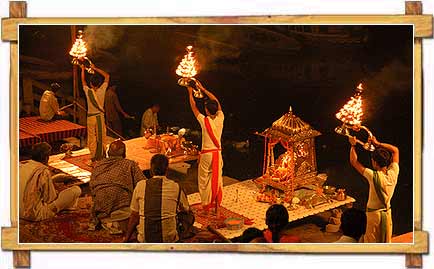
Ganga Aarti on the Ganga Ghat in Varanasi

Ganga Aarti on the Ganga Ghat in Varanasi

Dhamek Stupa at Sarnath

Dhamek Stupa at Sarnath

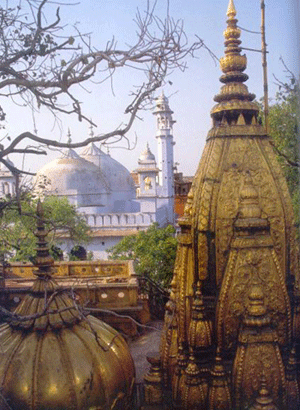
Kashi Vishwanath Temple of Varanasi

Kashi Vishwanath Temple of Varanasi
Showing posts with label what to see in Varanasi. Show all posts

Friday, March 12, 2010

Tourist Spots in Varanasi - Saint Kabir Das Memorial Temple at Kabirchaura in Varanasi


Of the many saints who lived and taught in Varanasi, the name of Kabir Das towers above the rest for his revolutionary thoughts and preaching’s as early as the 1440 AD. Legend has it that a Muslim weaver couple of Varanasi found an infant beside a lake in Kashi(Varanasi) and named him Kabir. Though some people believed him to be the son of high caste Brahmin who had cast him away. There is no concrete evidence on the exact place of birth of Kabir or who were the original parent’s? Nevertheless, Kabir Das was revered equally by the contemporary Hindus and Muslims.

Saint Kabir Das was a mystic poet whose work had a marked influence on the Bhakti Movement. His work is also included in the Guru Granth Sahib – the holy book of Sikhism and Kabir Das is considered one of the 15 Sikh Bhagats. The ‘Kabir Panthi’s” is a religious community that considers Kabir Das as its founding father and proudly carry forward his legacy even today. Kabir’s teachings are mainly in the form of two-line verses called ‘Dohas’. The basic religious principles he espoused are simple. According to Kabir, all life is interplay of two spiritual principles. One is the personal soul (Jivatma) and the other is God (Paramatma). It is Kabir's view that salvation is the process of bringing into union these two divine principles. Kabir Daspreached the oneness of all religions and was not supportive of the meaningless rituals of Hinduism or the mindless repetition of Islam. His writings were mainly based on the concept of reincarnation and karma. Kabir Das never really abandoned his worldly life to become a saint, choosing instead to balance his life between a traditional household person and a mystic who lived his life in a simplistic manner.
Kabit Das composed poems that were full of praise for the True Guru or Satguru. He never spoke of any human gurus in his poems. Being illiterate, his verses were always spoken in the vernacular Hindi as he could never express himself in writing. Sant Kabir’s greatest composition is the ‘Bijak’ (the seedling) – a collection of poems that resonate with the idea of the fundamental one. Kabir Das advocated the ‘Sahaja’ Path or the simple/natural way to oneness with the supreme being rather than following of complex religious rites.
Kabis Das left for his heavenly abode in the year 1518 at a place called Magahar near Gorakhpur in Uttar Pradesh. His mortal remains are preserved in a Samadhi-Mandir in the Kabir Chaura area of Varanasi. Since he was revered by both the Hindus and Muslims, after his death a Samadhi-Mandir was erected on the order of the ruler of Kashi –Raja Veerdev Singh Ju. This was done to appease both his Hindu and Muslim followers. This samadhi-mandir is built on 1600 square feet (40 X 40) of land in a square shape with baluwa stones. The chauki (the part of the temple just outside the main entrance and running across the periphery of the temple) is done in black and white marble and the temple’s ghanta-ghar is made of beautifully carved stone. The temple’s roof is considered a unique and outstanding piece of architecture. The temple’s dome and minaret are evidence of rare works of architecture and workmanship. The samadhi-mandir’s courtyard is now used for holding special ceremonies.

Monday, March 1, 2010

The exotic Rambagh Baradari in the Rambagh Gardens in Ramnagar, near Varanasi

The erstwhile Benares(another name for Varanasi) state was under the rule of Maharaji Chet Singh who ruled the state 200 years ago.Chet Singh had commissioned some magnificent buildings and gardens during his rule.One such enchanting garden is the Rambagh in Ramnagar near Varanasi, which has some rare varieties of flowers and medicinal plants. However, the prime attraction of Rambagh is the 'Baradari' where the Maharaja would sit with his royal entourage and enjoy the views of the surreal surroundings. The 'Baradari' is made from the rare 'Makrana stone' which is also used in the construction of the Taj Mahal, one of the seven wonders of the world.Elegant carved stone pillars support delicate arches with a decorative central seating area for the King. The Baradari was recently in news after reports came out that the rare stones of the baradari are breaking loose due to the careless activities of visitors as well as from the attack of the natural elements.Steps are being taken to dismantle the weaker sections and send them for repair and to replace some of the stone sections with the equally strong 'Chunar' stones which are found in the nearby region and which were also used in the construction of forts and palaces.Since the 'makrana' stones are extremely rare, the 'Chunar' stones seem a viable alternative.Recently, the current king of Kashi, Kunwar Anant Narayan Singh also visited the 'Baradari' to ascertain the extent of damage to the heritage structure.The Rambagh Baradari is a sterling example of the intricate stone-based architectural design that was the trademark of the artisans of this region and which now, unfortunately is well on its way to becoming a thing of the past.

Friday, February 26, 2010

Top Ten Places to See in Varanasi

1) Varanasi Ghats: The ghats on the banks of the river Ganges are the soul of Varanasi. The ghats are virtually the kaleidoscope of belief, customs and traditions that constitute the philiosphy that is Varanasi. There are 84 ghats in number – huge rectangular stairs that lead to the river edge. Some of them were built as early as the 12 century while others have a more recent origin..
2) Kashi Vishwanath Temple: Originally built in 1776 by Maharani Ahilya Devi of Indore, the towers of the temple were gold plated by the Maharaja Ranjit Singh in 1835 who donated 1000 kg of gold. The ‘shivalinga’ in the temple 60 cm tall and 90 cm in circumference housed in a silver altar.
3) St. Mary’s Church: St. Mary’s is probably the oldest Protestant Church in North India outside Calcutta. The foundation stone was laid on 29th April 1810 by Daniel Corrie. This beautiful Church is situated in 11.25 acres of land and has historic background which will be seen from the monuments in the campus of British soldiers who died in action. St Mary"s Church is situated in the cantonment area of Varanasi. This church has a low tower, spire and projecting portico. There are three simple louvered doors beneath plain cornices alternating with two bays, each with white plaster niches. Above each doorway is a rectangular fanlight, protected from the glare of the sun by a plain timber canopy - a simple device which has a major architectural impact.
4) Manikarnika Ghat: Also known as the “Mahashamsana’ or the ‘ Great Cremation Ground of the World’, Manikarnika ghat is where dead are brought from all over the country to be cremated by fire. There is a ‘sacred fire’ that has been burning since centuries and it is the fire from this that is used for the cremation. It is believed that those who are cremated at Manikarnika ghat attain moksha and their souls are set free from the endless cycle of birth and death.
5) Bharat Kala Bhavan: An archaeological museum built in the campus of the Banaras Hindu University. Established in 1920, the museum has vast collection of over 100,000 artifacts like paintings, textiles, costumes, decorative arts, Indian philately and literary and archival materials. The first floor has Numismatic Gallery (collection of coins), Archaeological Gallery, Decorative Art Gallery, Benaras Through the Ages Gallery and Galleries on Alice Boner and M. K. Gupta. There are some proposed extensions of galleries like the Gallery of Archive and Literary Materials, Gallery on Textiles and Costumes and a Gallery of Metal Images.
6) Ramnagar Fort : This fort-palace was built in the eighteenth century and is the home of the king of Kashi( or Varanasi). Built in red sandstone, the fort has a museum displaying the Royal collection which includes vintage Cars, Royal palkies, an armory of swords and old guns, ivory work and antique clocks. Also, on display are ornate palanquins, gold-plated howdahs and weapons.
7) Chunar Fort: Built by Maharaja Vikramaditya, the king of Ujjain(in Madhyapradesh), this fort had been the stronghold of Babar followed by Shershah Suri, Humayun, Akbar, Aurangzeb and finally,’ the Britishers. Chunar fort is constructed at a height of 80’ to 175’ from the land level of Chunar. The fort area is approx. 3400 Sq. yard, its length is 800 yard & width is 133 to 300 yard. The Chunar Fort is located at a distance of 42 kilometers fron Varanasi city. Worth seeing inside the fort are the Sonva Mandap, Raja Bhartihari Samadhi, Bavan Khamba & Solar Watch.
8) Sarnath : A small town barely 12 kms from Varanasi rail junction, Sarnath is one of the most important Buddhist pilgrimage and heritage site. This is where the Lord Buddha delivered his first sermon. Sarnath is home to the excavated remains of the ancient Buddhist monasteries, the famous Lion capital – India’s national emblem, a archaeological museum, huge stupas including the Dhamek and Chaukhandi Stupa and many Buddhist temples built here by missions from Japan, China, Tibet, Cambodia and others.
9) Nepali Temple: This unique temple is situated on the Lalita Ghat on the bank of the river Ganges. The temple was commissioned by the King of Nepal and is built in the Nepali style of architecture by workers who were brought from Nepal to create this marvel. The wood used in the temple is also found in Nepal. The specialty of the wood used in the temple is that termites do not eat this wood. The temple features magnificent wood work and there are erotic wooden sculptures built in to the external columns and facades.Due to the erotic sculptures, it is also called ‘mini-khajuraho’. Another popular name for this temple is the ‘kaathwala’ temple.
10) Lakhania Dari Caves and Waterfall: Located at a distance of around 45 kms from Varanasi are the beautiful small hills of the Vindhyanchal mountain ranges. Ensconced in the hills is a mesmerizing waterfall that drains in to a small clear water lake. This is the Lakhania Dari. A small stream originates from the lake and huge boulders are strewn all over the two km long trek that leads to the waterfall from the lake. Ancient rock caves can be seen on the rocky face of the hills that surround the region. A visual treat for nature lovers and adventure seekers.